


Product Description
by Stefan Brosig (Author)
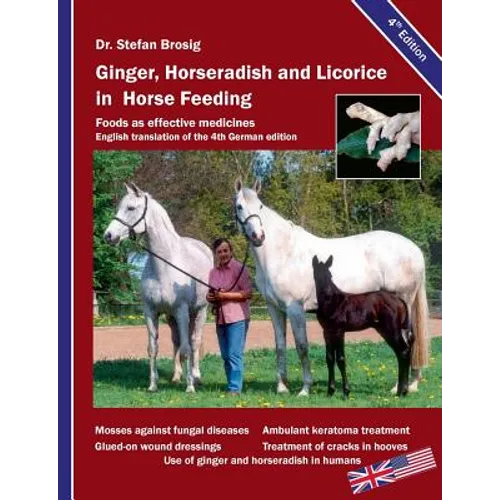
Since 2002 ginger is used in horses for the treatment of a wide range of ailments, mainly in cases of injury or age-related arthrosis and inflammation. Since 2010, its efficacy has also been "officially recognized" and put on the doping list. As a healthy spice, it will probably be the only harmless drug that can be used for the entire life The successful treatment of the famous German dressage mare and former great Olympic hope Renaissance Fleur in 2003 led to a rapid spread of ginger feeding among the horse owners in Germany. ("The greatest progress in horse feeding since the introduction of hay and oats " Quote from a user) In 2004, horseradish was added to the anti-inflammatory ginger as an effective broadband antibiotic. In 2009, licorice was added as a treatment against headshaking. The book reflects the current state of feeding ginger, horseradish and licorice and provides practical guidance on how to use it. The book also includes the effective treatment of fungal skin diseases with broadband antifungal mosses. Furthermore, the ambulant treatment of keratomas is described, the treatment of sandcracks by gluing over with glass fiber tissue and a gastric-juice-resistant encapsulation of ginger for use in humans. In addition, a gentle treatment of equine sarcoids with liverwort extract and cod liver oil is described. And finally, it is described a very simple method of affixing bandages over wounds by gluing, which (because too cheap ) unfortunately is only very rarely used by veterinarians. As a prophylaxis to orthopedic problems, the quite new hoof-caring method F-Balance, tested and found superior by the University of Leipzig, is also emphasized.
Author Biography
Stefan Brosig was born in Möglingen/Germany in 1959. He studied chemistry and obtained his doctorate in the field of physical chemistry. Even before graduating, riding became his hobby. Since 1986 he always keeps one or more horses. In 1995, he completed a trainer course for horse ownwers in the stable of Germany's most successful gallop race trainer Heinz Jentzsch. Keeping horses also inevitably led to preoccupation with the health and feeding of these animals. As a natural scientist, he could not overlook some mistakes of modern medicine. Therefore, in some cases where conventional veterinary medicine was unable to help, he developed more effective and more gentle treatments for his horses, which are now spreading rapidly. In addition to the book "Ginger, horseradish and licorice in horse feeding" he published, but only in German language, a description of the classical way of training the thoroughbred racehorse).











