Product Description
by Tony Schenk (Author)
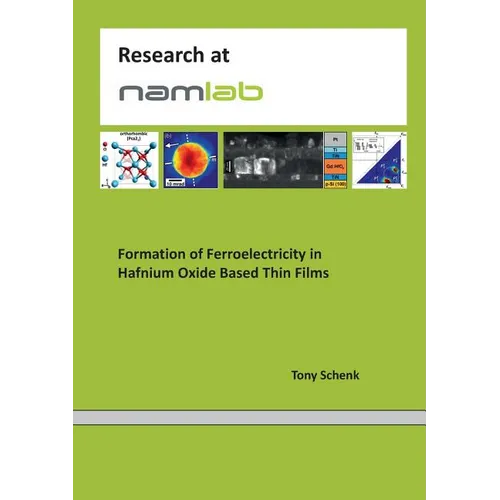
In 2011, B scke et al. reported the unexpected discovery of ferroelectric properties in hafnia based thin films, which has since initiated many further studies and revitalized research on the topic of ferroelectric memories. In spite of many efforts, the unveiling of the fundamentals behind this surprising discovery has proven rather challenging. In this work, the originally claimed Pca21 phase is experimentally proven to be the root of the ferroelectric properties and the nature of this ferroelectricity is classified in the frame of existing concepts of ferroelectric materials. Parameters to stabilize this polar phase are examined from a theoretical and fabrication point of view. With these very basic questions addressed, the application relevant electric field cycling behavior is studied. The results of first-order reversal curves, impedance spectroscopy, scanning transmission electron microscopy and piezoresponse force microscopy significantly advance the understanding of structural mechanisms underlying wake-up, fatigue and the novel phenomenon of split-up/merging of transient current peaks. The impact of field cycling behavior on applications like ferroelectric memories is highlighted and routes to optimize it are derived. These findings help to pave the road for a successful commercialization of hafnia based ferroelectrics.
Author Biography
Tony Schenk received his B.Eng. degree in Microtechnology (dual) and M.Eng. degree in Nano- and Surface Technology from the Westsaxon University of Applied Sciences Zwickau in 2011 and 2012, respectively. He joined NaMLab in 2012 to work on hafnia/zirconia based ferroelectrics. Within the frame of these activities, he authored and co-authored more than 20 peer-reviewed articles and received his doctoral degree from TU Dresden in 2016.