


Product Description
by Günter Musmann (Editor)
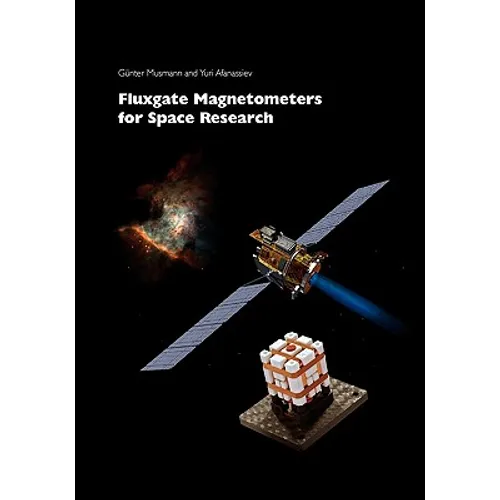
All fluxgate magnetometers are based on the theory of H.Aschenbrenner and G.Goubau developed in 1936 and the first fluxgates developed by F.F rster.Already the early satellites like putnik 3(Dolginov-Russia,1958), Mariner 4 (NASA/USA,1964), the first German satellite AZUR (Musmann, 1969) studying the magnetic fields of the Earth, Moon, Venus, Mars and other planets were using fluxgate magnetometers up to the latest NASA/ESA investigations on CASSINI (1998), and ESA's Rosetta(2004) and the first Ion Engine spacecraft\, NASA-DEEP-SPACE-ONE(Musmann/Kuhnke,1998), (see cover.) Very precise Earth magnetic field measurements in space have been made using fluxgate magnetometers in combination with scalar magnetometers (MAGSAT-Acuna,1979;OERSTED -Primdahl,1999;CHAMP-L hr,2000) Only a few detailed descriptions about the theory and how to design and calibrate space fluxgate magnetometers and how to get reliable accurate magnetic field component measurements in space have been published.Therefore the worldwide small space fluxgate magnetometer community decided to document and save all their relevant know-how on space fluxgate magnetometers in this book before retirement.
Author Biography
Günter Musmann (editor), born 1938 in Salzgitter-Bad, studied Physics in Göttingen and Braunschweig, PhD 1968 in Physics.1964 a fluxgate magnetometer experiment on the first German satellite AZUR, launched 1968.Since those days he has developed and launched together with his collegues from Germany, Russia, USA, UK, France, Italy, Denmark numerous fluxgate magnetometer experiments (DIAL, HeliosA+B, GIOTTO, MARS94/96, CLUSTER, Tether1+2, studying the EARTH and other planets magnetic fields on sattelites and spacecrafts up to the latest NASA ion engine spacecraft Deep Space One and NASA/ESA's Cassini to Saturn and ESA's ROSETTA, still on its way to comet 67P/Churyumov-Gerasimenko(arrival 2014). Besides those investigations he has successfully launched several rocket magnetic field experiments into the Equatorial -and Polar Electrojet and conducted several Geothermal Research projects .











