Product Description
by David Ardia (Author)
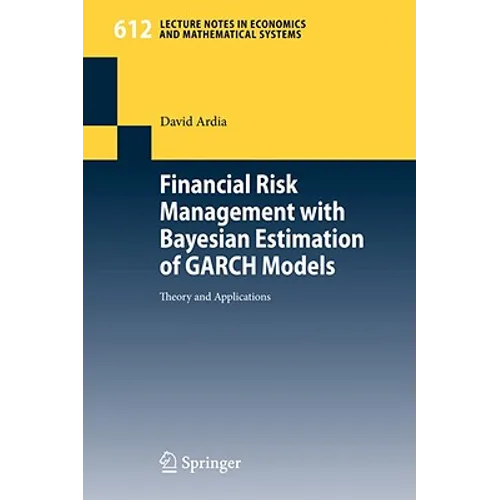
This book presents in detail methodologies for the Bayesian estimation of sing- regime and regime-switching GARCH models. These models are widespread and essential tools in n ancial econometrics and have, until recently, mainly been estimated using the classical Maximum Likelihood technique. As this study aims to demonstrate, the Bayesian approach o ers an attractive alternative which enables small sample results, robust estimation, model discrimination and probabilistic statements on nonlinear functions of the model parameters. The author is indebted to numerous individuals for help in the preparation of this study. Primarily, I owe a great debt to Prof. Dr. Philippe J. Deschamps who inspired me to study Bayesian econometrics, suggested the subject, guided me under his supervision and encouraged my research. I would also like to thank Prof. Dr. Martin Wallmeier and my colleagues of the Department of Quantitative Economics, in particular Michael Beer, Roberto Cerratti and Gilles Kaltenrieder, for their useful comments and discussions. I am very indebted to my friends Carlos Ord as Criado, Julien A. Straubhaar, J er ome Ph. A. Taillard and Mathieu Vuilleumier, for their support in the elds of economics, mathematics and statistics. Thanks also to my friend Kevin Barnes who helped with my English in this work. Finally, I am greatly indebted to my parents and grandparents for their support and encouragement while I was struggling with the writing of this thesis.
Back Jacket
For his excellent monograph, David Ardia won the Chorafas prize 2008 at the University of Fribourg Switzerland.
This book presents methodologies for the Bayesian estimation of GARCH models and their application to financial risk management. The study of these models from a Bayesian viewpoint is relatively recent and can be considered very promising due to the advantages of the Bayesian approach, in particular the possibility of obtaining small-sample results and integrating these results in a formal decision model. The first two chapters introduce the work and give an overview of the Bayesian paradigm for inference. The next three chapters describe the estimation of the GARCH model with Normal innovations and the linear regression models with conditionally Normal and Student-t-GJR errors. The sixth chapter shows how agents facing different risk perspectives can select their optimal Value at Risk Bayesian point estimate and documents that the differences between individuals can be substantial in terms of regulatory capital. The last chapter proposes the estimation of a Markov-switching GJR model.