Feminist Global Health Security - Hardcover
Available Offers
Fastest Delivery Tomorrow With Vip DealOrder within 1 hr 8 mins.
Instant 10% Discount On HDFC Banks Credit/Debit Cards EMI and CreditCard
Couldn't load pickup availability
Product Details
Flight Range: Up to 1,000 meters (3,280 feet)
Maximum Speed: 45 kilometers per hour (28 miles per hour)
Shipping And Return
For all orders exceeding a value of 100USD shipping is offered for free.
Returns will be accepted for up to 10 days of Customer’s receipt or tracking number on unworn items. You, as a Customer, are obliged to inform us via email before you return the item.
Otherwise, standard shipping charges apply. Check out our delivery Terms & Conditions for more details.
Product Description
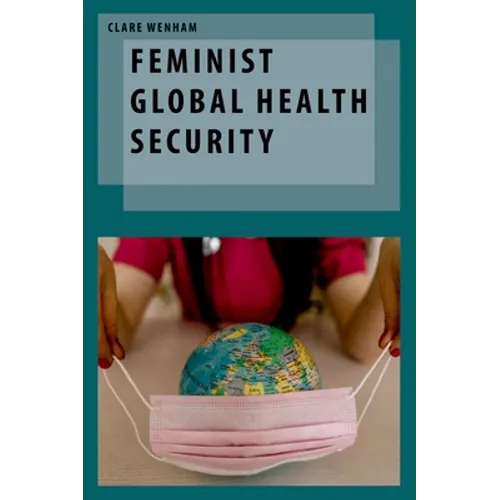
by Clare Wenham (Author)
When Zika made headlines in 2016, images of women cradling babies affected with microcephaly spread across the media and pulled on heartstrings. But, as this book argues, whilst this outbreak was about women and babies, this outbreak also highlighted the lack of gendered considerations in global health security. The policy response to Zika focused on limiting the spread of the virus through domestic and civic cleaning to remove mosquitoes and by asking women to defer pregnancy. Both of these actions are inherently gendered, placing the burden of responsibility for stemming the spread of disease on women.
By taking Zika as its primary case but also touching on COVID-19, Feminist Global Health Security asks what the policy response to disease outbreaks tell us about the role of women in global health security. More broadly, what would global health policy look like if it were to take gender seriously, and how would this impact global disease control? Beyond raising questions of gender equity, Clare Wenham also considers global health security's lack of consideration for sustainability in epidemic preparedness and response. Wenham argues that global health security in general has thus far lacked a substantive feminist engagement, with the result that the very policies created to manage an outbreak of disease disproportionately fail to protect women. We know that women have biological pre-disposition and social vulnerability to contracting a number of infectious diseases, making them more susceptible to infection. Yet, the dominant gender-blind policy narrative of global health securityhas created pathways which focus on protecting the international spread of disease and state economies, rather than protecting those who are most likely to be affected. As such, the state-based structure of global health security provides the fault line for global health security's failure to engage women. This book highlights the ways in which women are disadvantaged by global health security policy, through engagement with feminist international relations concepts of visibility, social and stratified reproduction, intersectionality, and structural violence. Wenham argues that it was no coincidence that poor, Black women living in low-quality housing were the most affected by the Zika outbreak and will continue to be so amid all epidemics, until meaningful engagement with gender is incorporated into global health security. As many news reports have made clear during COVID, there has been a recent sea change in thinking about the secondary effects of infectious disease control policy on women. However, we have yet to see this reflected in global health policy.
Author Biography
Clare Wenham is Assistant Professor of Global Health Policy at London School of Economics and Political Science (LSE). She specializes in global health security and the politics and policy of pandemic preparedness and outbreak response, through analysis of influenza, Ebola, Zika, and COVID-19. Her
work has been featured in The Lancet, BMJ, Security Dialogue, International Affairs, BMJ Global Health and Third World Quarterly.