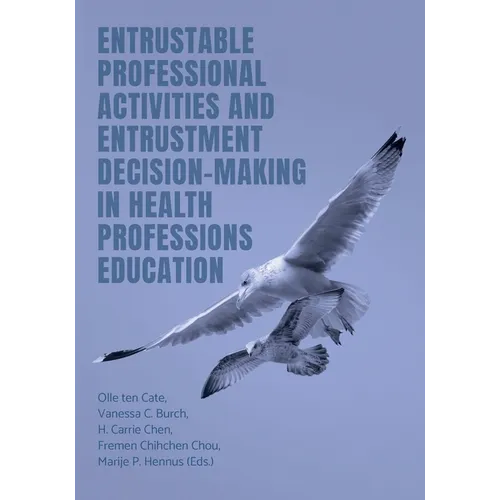
Entrustable Professional Activities and Entrustment Decision-Making in Health Professions Education - Paperback
Available Offers
Fastest Delivery Tomorrow With Vip DealOrder within 1 hr 8 mins.
Instant 10% Discount On HDFC Banks Credit/Debit Cards EMI and CreditCard
Couldn't load pickup availability
Product Details
Flight Range: Up to 1,000 meters (3,280 feet)
Maximum Speed: 45 kilometers per hour (28 miles per hour)
Shipping And Return
For all orders exceeding a value of 100USD shipping is offered for free.
Returns will be accepted for up to 10 days of Customer’s receipt or tracking number on unworn items. You, as a Customer, are obliged to inform us via email before you return the item.
Otherwise, standard shipping charges apply. Check out our delivery Terms & Conditions for more details.
Product Description
by Olle Ten Cate (Editor), Vanessa C. Burch (Editor), H. Carrie Chen (Editor)
Since the turn of the millennium, competency-based education (CBE) has become a new standard for training in the health professions in many countries. Early work to operationalize CBE has included development of detailed frameworks of competencies that every physician should demonstrate. However, these models were criticized because of a lack of connection with the everyday work in health care, and with what it means to be a health professional. For that reason, the concept of entrustable professional activities (EPAs) was introduced in 2005, to supply the missing link between competency frameworks, and the practice of healthcare. EPAs are units of professional practice that may be entrusted to trainees once they show the competencies needed to execute them without supervision. EPAs constitute a holistic concept, requiring a coherent integration of various competencies. EPAs have become popular within competency-based programs in many countries, with numerous examples not only in medicine but in all health professions, including nursing, veterinary medicine, pharmacy, physical therapy, dentistry, and others.
This book provides an overview of key foundational concepts related to EPAs. Beginning with a historical overview, the first chapter provides a definition and rationale for EPAs. While competencies are qualities of individuals, EPAs are units of work. The two can be seen as dimensions of a matrix. Almost all activities in health care draw upon multiple, integrated competencies (communication and collaboration skill, professional behavior, content expertise, etc.). Next, entrustment decision-making as an approach to assessment is explained, as well as the associated framework of levels of supervision, ranging from 'allowed to observe' to 'ready to be a supervisor.' The chapter concludes with a summary of important considerations for building an EPA program.
The book has 24 chapters and is organized in five sections, regarding theoretical backgrounds, definitions and elaborations of entrustable professional activities, implications for curriculum development, implications for assessment, and implications for implementation of the management of curricular change and faculty development.
Fifty authors from all continents have contributed to chapters in the book. All authors are active scholars in health professional education and have experiences with the use, development or research of entrustable professional activities and entrustment decision-making.