Skip to content
Welcome To Our Store.
100,000+ Products for Home, Medical, Office & Classroom Needs
Search
Skip to product information
1 of 1

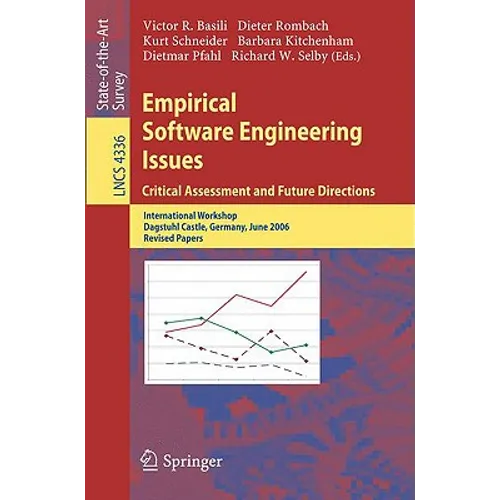
Empirical Software Engineering Issues. Critical Assessment and Future Directions: International Workshop, Dagstuhl Castle, Germany, June 26-30, 2006, - Paperback

$89.08
$89.08
Sale Sold out
Shipping calculated at checkout.
In stock (100 units), ready to be shipped

Available Offers

Fastest Delivery Tomorrow With Vip DealOrder within 1 hr 8 mins.

Instant 10% Discount On HDFC Banks Credit/Debit Cards EMI and CreditCard

Secure checkout with
  • American Express
  • Apple Pay
  • Diners Club
  • Discover
  • Google Pay
  • Mastercard
  • PayPal
  • Shop Pay
  • Visa

Flight Range: Up to 1,000 meters (3,280 feet)

Maximum Speed: 45 kilometers per hour (28 miles per hour)

For all orders exceeding a value of 100USD shipping is offered for free.

Returns will be accepted for up to 10 days of Customer’s receipt or tracking number on unworn items. You, as a Customer, are obliged to inform us via email before you return the item.

Otherwise, standard shipping charges apply. Check out our delivery Terms & Conditions for more details.

View Product Details
Shopping cart
Product Product subtotal Quantity Price Product subtotal
Empirical Software Engineering Issues. Critical Assessment and Future Directions: International Workshop, Dagstuhl Castle, Germany, June 26-30, 2006, - Paperback
$89.08/ea
$0.00
$89.08/ea $0.00

Product Description

by Victor Basili (Editor), Dieter Rombach (Editor), Kurt Schneider (Editor)

Victor R. Basili, Dieter Rombach, and Kurt Schneider Introduction In 1992, a Dagstuhl seminar was held on "Experimental Software Engineering Issues" (seminar no. 9238). Its goal was to discuss the state of the art of empirical software engineering (ESE) by assessing past accomplishments, raising open questions, and proposing a future research agenda. Since 1992, the topic of ESE has been adopted more widely by academia as an interesting and promising research topic, and in industrial practice as a necessary infrastructure technology for goal-oriented, sustained process improvement. At the same time, the spectrum of methods applied in ESE has broadened. For example, in 1992, the empirical methods applied in software engineering were basically restricted to quantitative studies (mostly controlled experiments), whereas since then, a range of qualitative methods have been introduced, from observational to ethnographical studies. Thus, the field can be said to have moved from experimental to empirical software engineering. We believe that it is now time to again bring together practitioners and researchers to identify both the progress made since 1992 and the most important challenges for the next five to ten years.

Number of Pages: 196
Dimensions: 0.46 x 9.25 x 6 IN
Publication Date: March 30, 2007
you might like