


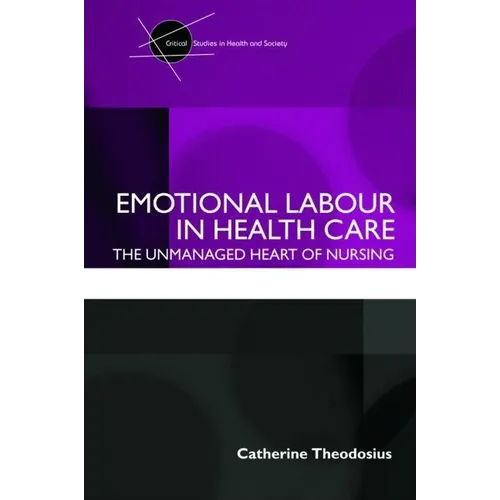
Emotional Labour in Health Care: The unmanaged heart of nursing - Paperback
Available Offers
Fastest Delivery Tomorrow With Vip DealOrder within 1 hr 8 mins.
Instant 10% Discount On HDFC Banks Credit/Debit Cards EMI and CreditCard
Couldn't load pickup availability
Product Details
Flight Range: Up to 1,000 meters (3,280 feet)
Maximum Speed: 45 kilometers per hour (28 miles per hour)
Shipping And Return
For all orders exceeding a value of 100USD shipping is offered for free.
Returns will be accepted for up to 10 days of Customer’s receipt or tracking number on unworn items. You, as a Customer, are obliged to inform us via email before you return the item.
Otherwise, standard shipping charges apply. Check out our delivery Terms & Conditions for more details.
Product Description
by Catherine Theodosius (Author)
Do nurses still care? In today's inflexible, fast-paced and more accountable workplace where biomedical and clinical models dominate health care practice, is there room for emotional labour?
Based on original empirical research, this book delves into personal accounts of nurses' emotion expressions and experiences as they emerge from everyday nursing practice, and illustrates how their emotional labour is adapting in response to a constantly changing work environment.
The book begins by re-examining Arlie Hochschild's sociological notion of emotional labour, and combines it with Margaret Archer's understanding of emotion and the inner dialogue. In an exploration of the nature of emotional labour, its historical and political context, and providing original, but easily recognisable, typology, Catherine Theodosius emphasises that it is emotion - complex, messy and opaque - that drives emotional labour within health care. She suggests that rather than being marginalised, emotional labour in nursing is frequently found in places that are hidden or unrecognised. By understanding emotion itself, which is fundamentally interactive and communicative, she argues that emotional labour is intrinsically linked to personal and social identity. The suggestion is made that the nursing profession has a responsibility to include emotional labour within personal and professional development strategies to ensure the care needs of the vulnerable are met.
This innovative volume will be of interest to nursing, health care and sociology students, researchers and professionals.
Author Biography
Catherine Theodosius recently completed an ESRC postdoctoral fellowship at the University of Essex and is a Lecturer in Adult Nursing at University Campus Suffolk.











