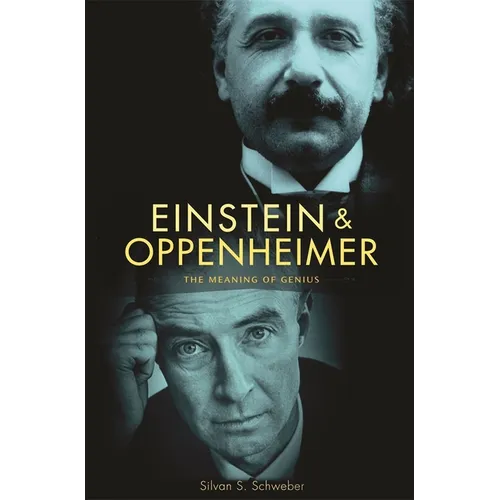
Einstein and Oppenheimer: The Meaning of Genius - Paperback
Available Offers
Fastest Delivery Tomorrow With Vip DealOrder within 1 hr 8 mins.
Instant 10% Discount On HDFC Banks Credit/Debit Cards EMI and CreditCard
Couldn't load pickup availability
Product Details
Flight Range: Up to 1,000 meters (3,280 feet)
Maximum Speed: 45 kilometers per hour (28 miles per hour)
Shipping And Return
For all orders exceeding a value of 100USD shipping is offered for free.
Returns will be accepted for up to 10 days of Customer’s receipt or tracking number on unworn items. You, as a Customer, are obliged to inform us via email before you return the item.
Otherwise, standard shipping charges apply. Check out our delivery Terms & Conditions for more details.

Product Description
by Silvan S. Schweber (Author)
Albert Einstein and J. Robert Oppenheimer, two iconic scientists of the twentieth century, belonged to different generations, with the boundary marked by the advent of quantum mechanics. By exploring how these men differed--in their worldview, in their work, and in their day--this book provides powerful insights into the lives of two critical figures and into the scientific culture of their times. In Einstein's and Oppenheimer's philosophical and ethical positions, their views of nuclear weapons, their ethnic and cultural commitments, their opinions on the unification of physics, even the role of Buddhist detachment in their thinking, the book traces the broader issues that have shaped science and the world.
Einstein is invariably seen as a lone and singular genius, while Oppenheimer is generally viewed in a particular scientific, political, and historical context. Silvan Schweber considers the circumstances behind this perception, in Einstein's coherent and consistent self-image, and its relation to his singular vision of the world, and in Oppenheimer's contrasting lack of certainty and related non-belief in a unitary, ultimate theory. Of greater importance, perhaps, is the role that timing and chance seem to have played in the two scientists' contrasting characters and accomplishments--with Einstein's having the advantage of maturing at a propitious time for theoretical physics, when the Newtonian framework was showing weaknesses. Bringing to light little-examined aspects of these lives, Schweber expands our understanding of two great figures of twentieth-century physics--but also our sense of what such greatness means, in personal, scientific, and cultural terms.