Product Description
by Mario Graziano (Author)
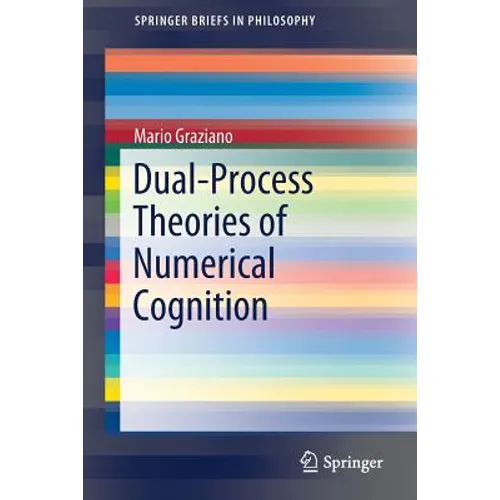
This book presents a philosophical interpretation to numerical cognition based on dual process theories and heuristics. It shows how investigations in cognitive science can shed light on issues traditionally raised by philosophers of mathematics. The analysis will also help readers to better understand the relationship between current neuroscientific research and the philosophical reflection on mathematics.
The author seeks to explain the acquisition of mathematical concepts. To accomplish this, he needs to answer two questions. How can the concepts of approximate numerosity become an object of thought that is so accessible to our consciousness? How are these concepts refined and specified in such a way as to become numbers? Unfortunately, there is currently no model that can truly demonstrate the role of language in the development of numerical skills starting from approximate pre-verbal skills.
However, the author details a solution to this problem: dual process theories. It is an approach widely used by theorists focusing on reasoning, decision making, social cognition, and consciousness. Here, he applies this approach to the studies on mathematical knowledge. He details the results brought about by psychological and neuroscientific studies conducted on numerical cognition by key neuroscientists. In the process, he develops the foundations of a new, potential philosophical explanation on mathematical knowledge.
Back Jacket
This book presents a philosophical interpretation to numerical cognition based on dual process theories and heuristics. It shows how investigations in cognitive science can shed light on issues traditionally raised by philosophers of mathematics. The analysis will also help readers to better understand the relationship between current neuroscientific research and the philosophical reflection on mathematics.
The author seeks to explain the acquisition of mathematical concepts. To accomplish this, he needs to answer two questions. How can the concepts of approximate numerosity become an object of thought that is so accessible to our consciousness? How are these concepts refined and specified in such a way as to become numbers? Unfortunately, there is currently no model that can truly demonstrate the role of language in the development of numerical skills starting from approximate pre-verbal skills.
However, the author details a solution to this problem: dual process theories. It is an approach widely used by theorists focusing on reasoning, decision making, social cognition, and consciousness. Here, he applies this approach to the studies on mathematical knowledge. He details the results brought about by psychological and neuroscientific studies conducted on numerical cognition by key neuroscientists. In the process, he develops the foundations of a new, potential philosophical explanation on mathematical knowledge.