Product Description
by Patrick Stakem (Author)
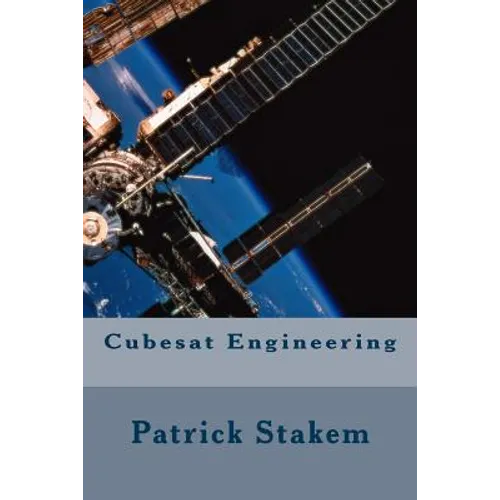
This book is an introduction to Cubesats, those popular and relatively inexpensive modular spacecraft that are upending the aerospace world. They have been built and deployed by colleges and Universities around the world, as well as high schools and elementary schools, even individuals. This is because Cubesats are modular, standard, and relatively low cost. The expensive part is the launch, but that is addressed by launch fixtures compatible with essentially ever launch on the planet. Although you may not have much of a choice in the orbit.Student Cubesat Projects are usually open source, may be world-wide in scope, and collaborative.At the same time, professionals in aerospace have not failed to consider the Cubesat architecture as an alternative for small-sat missions. This can reduce costs by one or two orders of magnitude. There are Cubesats on the International Space Station, and these can be returned to Earth on a resupply mission. There is a large "cottage industry' developed around the Cubesat architecture, addressing "professional" projects with space-rated hardware. NASA itself has developed Cubesat hardware (Pi-Sat) and Software (cfs).Cubesats are modular, built to a standard, and mostly open-source. The downside is, approximately 50% of Cubesat missions fail. We hope to point out some approaches to improve this. If you define and implement your own Cubesat mission, or work as a team member on a larger project, this book presents and points to information that will be valuable. Even if you never get your own Cubesat to orbit, you can be a valuable addition to a Cubesat or larger aerospace project. Shortly, two NASA Cubesats will be heading to Mars. The unique Cubesat architecture introduces a new Paradigm for exploring the many elements of our Solar System. Best of luck on your mission.
Author Biography
The author began his career in Aerospace with Fairchild Industries on the ATS-6 (Applications Technology Satellite-6) program, a communication satellite that developed much of the technology for the TDRSS (Tracking and Data Relay Satellite System). He followed the ATS-6 Program through its operational phase, and worked on other projects at NASA's Goddard Space Flight Center including the Hubble Space Telescope, the International Ultraviolet Explorer (IUE), the Solar Maximum Mission (SMM), some of the Landsat missions, and Shuttle. He was posted to NASA's Jet Propulsion Laboratory for MARS-Jupiter-Saturn (MJS-77), which later became the Voyager mission, and is still operating and returning data from outside the solar system at this writing. He initiated and lead the Flight Linux Project for NASA's Earth Sciences Technology Office. Mr. Stakem is affiliated with the Whiting School of Engineering of the Johns Hopkins University, and Capitol Technology University. Mr. Stakem supported the Summer Engineering Bootcamp Projects at Goddard Space Fight Center for 2 years. He developed and presented Cubesat courses.