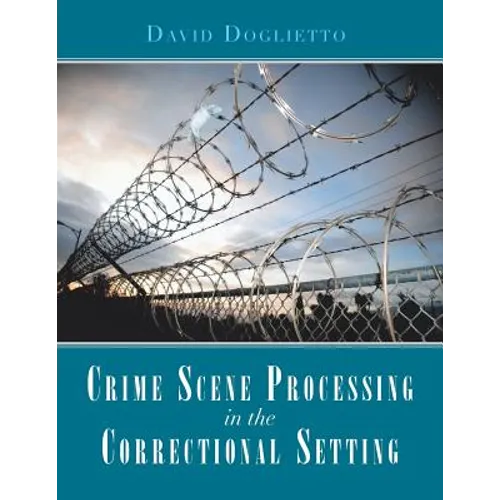
Crime Scene Processing in the Correctional Setting - Paperback
Available Offers
Fastest Delivery Tomorrow With Vip DealOrder within 1 hr 8 mins.
Instant 10% Discount On HDFC Banks Credit/Debit Cards EMI and CreditCard
Couldn't load pickup availability
Product Details
Flight Range: Up to 1,000 meters (3,280 feet)
Maximum Speed: 45 kilometers per hour (28 miles per hour)
Shipping And Return
For all orders exceeding a value of 100USD shipping is offered for free.
Returns will be accepted for up to 10 days of Customer’s receipt or tracking number on unworn items. You, as a Customer, are obliged to inform us via email before you return the item.
Otherwise, standard shipping charges apply. Check out our delivery Terms & Conditions for more details.
Product Description
by David Doglietto (Author)
There is no more challenging a crime scene than that found in the custodial setting. Unlike on the streets where a first responder, or pair of responders, can take command of an incident quickly to preserve the integrity of the scene and the evidence it contains, the crime scene investigator in a jail or prison is not so fortunate. The jail or prison crime scene investigator will naturally be faced with a crime scene that is already contaminated, either by the routine and constant trudging of a confined inmate population or by the efforts of staff to restore order. Thus, the discovery of DNA from any one incarcerated individual is not as compelling to the event as it would be in the general public. Furthermore, custodial officials rely on the philosophy of "overwhelm and suppress" to control inmate disturbances. Therefore, the investigator will have to deal with an abundance of staff stuffed into a compact area of forensic importance. In the custodial setting, the focus of correctional staff is the prompt restoration of order with little concern for the evidence that the crime scene may contain. Crime Scene Processing in the Correctional Setting is a practical guide for sheriffs, wardens, superintendants, correctional investigative personnel, correctional officers and deputies written in a manner that is easy to understand, by someone who faced the challenges of processing crime scenes in the correctional setting.