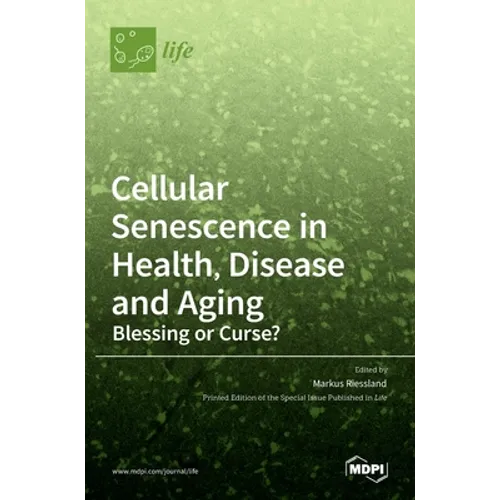
Cellular Senescence in Health, Disease and Aging: Blessing or Curse? - Hardcover
Available Offers
Fastest Delivery Tomorrow With Vip DealOrder within 1 hr 8 mins.
Instant 10% Discount On HDFC Banks Credit/Debit Cards EMI and CreditCard
Couldn't load pickup availability
Product Details
Flight Range: Up to 1,000 meters (3,280 feet)
Maximum Speed: 45 kilometers per hour (28 miles per hour)
Shipping And Return
For all orders exceeding a value of 100USD shipping is offered for free.
Returns will be accepted for up to 10 days of Customer’s receipt or tracking number on unworn items. You, as a Customer, are obliged to inform us via email before you return the item.
Otherwise, standard shipping charges apply. Check out our delivery Terms & Conditions for more details.
Product Description
by Markus Riessland (Guest Editor)
Dear Colleagues,
When Hayflick and Moorhead coined the term "cellular senescence" (CS) almost 60 years ago, this phenomenon was understood as a mechanism, usually induced by activation of the DNA-repair machinery, to prevent uncontrolled proliferation. Meanwhile, additional beneficial roles for CS have been identified, such as embryonic development and wound healing. The senescence associated secretory phenotype (SASP) activated in most senescent cells (SC) signals to the immune system "come here and remove me". In organisms with young and functional immune systems, occurring SC are usually detected and removed. If SC remain in the tissue expressing the SASP, this will cause not just a damaging local inflammation but can also induce remodeling and regeneration of the surrounding tissue as well as spreading of senescence. Old organisms show reduced regenerative potential and immune function which leads to accumulation of SC. Accordingly, accumulation of SC was observed in tissues of aged individuals, but importantly also in the context of age-related disorders, neurodegenerative, or cardiovascular diseases and others. Because of its detrimental effect of the surrounding tissue, accumulation of SC is not just a consequence, but can rather been understood as a major driver of aging. In line with this, recent studies described that removal of SC showed beneficial effects on healthspan and lifespan. This exciting research led to the discovery of "senolytics", drugs which can kill SC. Given the heterogeneity of cell types that show senescence-like phenotypes, including heart muscle and post-mitotic neuronal cells, further research is required to unravel the molecular background that renders a cell type vulnerable to senesce. Additionally, it will be important to understand how senescence is cell type-specifically induced and which molecules serve as drug targets to prevent senescence and its spreading, or actively kill SC. This special issue will shed light on the molecular pathways of CS and inflammaging and on possible strategies to interfere with these processes.
Dr. Markus Riessland
Guest Editor