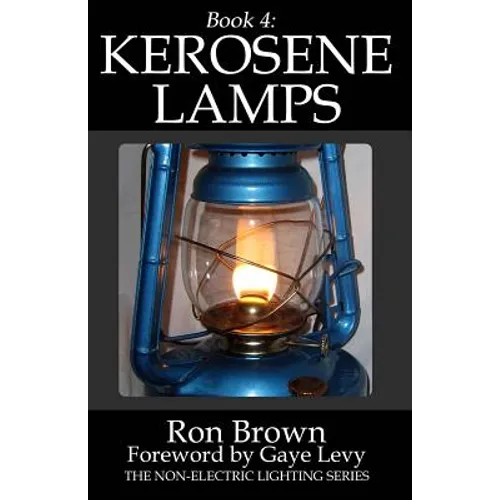
Book 4: Kerosene Lamps - Paperback
$16.18
$16.18
Sale
Sold out
Shipping calculated at checkout.
In stock (100 units), ready to be shipped
Available Offers
Fastest Delivery Tomorrow With Vip DealOrder within 1 hr 8 mins.
Instant 10% Discount On HDFC Banks Credit/Debit Cards EMI and CreditCard
Couldn't load pickup availability
Product Details
Flight Range: Up to 1,000 meters (3,280 feet)
Maximum Speed: 45 kilometers per hour (28 miles per hour)
Shipping And Return
For all orders exceeding a value of 100USD shipping is offered for free.
Returns will be accepted for up to 10 days of Customer’s receipt or tracking number on unworn items. You, as a Customer, are obliged to inform us via email before you return the item.
Otherwise, standard shipping charges apply. Check out our delivery Terms & Conditions for more details.
Product Description
by Gaye Levy (Foreword by), Ron Brown (Author)
★★★ Reader Feedback: Five Stars. Everything I expected and more - NE
● Kerosene Lamps is Book 4 of our Non-Electric Lighting Series. It covers wick-type kerosene lamps and lanterns and is intended for users, not antique dealers. How can we generate LIGHT? That is the question. ● Fuel substitutes, safety, operating procedures, maintenance, repair, and various lamp styles are the topics. Things to look for when buying used. Cost effectiveness. Homemade lamps. Candlepower. Those are the topics discussed. Collector value? Never mentioned. ★★★ Reader Feedback: Everyone should read this. - R.L. Ake ● This book covers the simple flat-wick lamps sold today in every Walmart and Family Dollar. But there's quite a bit more to it than that. ● As an adult, I happened to be at my parent's home one evening when a blackout occurred. My mother sent me to check on an elderly woman, a 90-year-old family friend, who lived alone. When she came to the door, I was stunned by the kerosene lamp she had burning in the living room. Whereas the kerosene lamp my parents kept tucked away for emergencies gave off light on par with a 71/2-watt nightlight, this woman's lamp was more like a 40-watt light bulb. It was not a Coleman lantern that hissed or needed pumping up. It was merely a wick-fed table lamp that ran on kerosene. The brand name was Rayo. Check 'em out on eBay. ● I later discovered that Rayos were on the market 20 years before Colemans. The Rayo wick, instead of being flat, was tubular, like a sock. The fire at the top of the wick formed a ring. Light output was striking. ● When I got home and told my mother about it, she smiled. "Oh yes. And in England they used to have Duplex lamps. They had two wicks instead of one. That's what they used during the War." Turns out Duplexes were introduced 30 years before Rayos. And gave off almost as much light as a Rayo. ● What? How could I have grown up so ignorant? This is technology from Grandpa's day. Surely, I MUST be a step ahead of Grandpa, no? ● Then again, maybe not. Maybe it's time to just back up a step and see what we've forgotten. I think most folks will be surprised. ★★★ Reader Feedback: I used to collect kerosene lamps and lanterns and have used them for decades. I still learned a lot from this book that I'd never known. In my opinion, this whole series is a must-have for every prepper or off-grid dweller. - totallyfrozen ★★★ Reader Feedback: Great source of general information on kerosene lanterns, parts, fuel, and technical information. A welcome addition to my library. - Charles T. Eilenstein ● Kerosene Lamps contains 10,000 words, 85 B&W illustrations, and is 61 pages long. It's available in Kindle eBook format as well as paper. ● This is an 8-book series. The quickest way to see the other titles is 1] to click on the Follow the Author link elsewhere on this page. Or 2] if you're not in Amazon as you read this, copy-and-paste "the non-electric lighting series" (including quote marks) into the Google search bar.
Number of Pages: 72
Dimensions: 0.15 x 8.5 x 5.5 IN
Publication Date: April 03, 2015