Product Description
by Klaus Mainzer (Author)
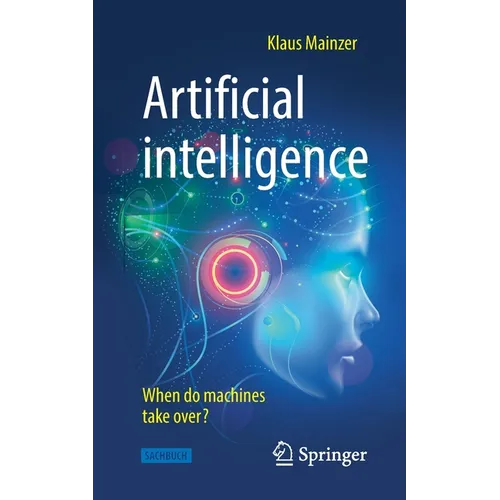
Everybody knows them. Smartphones that talk to us, wristwatches that record our health data, workflows that organize themselves automatically, cars, airplanes and drones that control themselves, traffic and energy systems with autonomous logistics or robots that explore distant planets are technical examples of a networked world of intelligent systems. Machine learning is dramatically changing our civilization. We rely more and more on efficient algorithms, because otherwise we will not be able to cope with the complexity of our civilizing infrastructure. But how secure are AI algorithms? This challenge is taken up in the 2nd edition: Complex neural networks are fed and trained with huge amounts of data (big data). The number of necessary parameters explodes exponentially. Nobody knows exactly what is going on in these "black boxes". In machine learning we need more explainability and accountability of causes and effects in order to be able to decide ethical and legal questions of responsibility (e.g. in autonomous driving or medicine)! Besides causal learning, we also analyze procedures of tests and verification to get certified AI-programs. Since its inception, AI research has been associated with great visions of the future of mankind. It is already a key technology that will decide the global competition of social systems. "Artificial Intelligence and Responsibility" is another central supplement to the 2nd edition: How should we secure our individual liberty rights in the AI world? This book is a plea for technology design: AI must prove itself as a service in society.
Back Jacket
Everybody knows them. Smartphones that talk to us, wristwatches that record our health data, workflows that organize themselves automatically, cars, airplanes and drones that control themselves, traffic and energy systems with autonomous logistics or robots that explore distant planets are technical examples of a networked world of intelligent systems. Machine learning is dramatically changing our civilization. We rely more and more on efficient algorithms, because otherwise we will not be able to cope with the complexity of our civilizing infrastructure.
But how secure are AI algorithms? This challenge is taken up here: Complex neural networks are fed and trained with huge amounts of data (big data). The number of necessary parameters explodes exponentially. Nobody knows exactly what is going on in these "black boxes". In machine learning we need more explainability and accountability of causes and effects in order to be able to decide ethical and legal questions of responsibility (e.g. in autonomous driving or medicine). Besides causal learning, we also analyze procedures of tests and verification to get certified AI-programs.
Since its inception, AI research has been associated with great visions of the future of mankind. It is already a key technology that will decide the global competition of social systems. "Artificial Intelligence and Responsibility" is another central supplement to this book: How should we secure our individual liberty rights in the AI world? This book is a plea for technology design: AI must prove itself as a service in society.
Author Biography
Prof. Klaus Mainzer studied mathematics, physics and philosophy at the University of Münster, where he also earned his doctorate in philosophy (1973) and habilitated. Before his appointment to the Chair of Philosophy and Philosophy of Science at the TUM and his appointment as Director of the Carl von Linde Academy in 2008, he worked as Professor (1981-1988) and Prorector (1985-1988) at the University of Konstanz and as Professor and Founding Director of the Institute for Interdisciplinary Computer Science (1988-2008) at the University of Augsburg. He is a member of numerous (inter)national committees and academies. From 2012 to 2014 he was founding director of the Munich Center for Technology in Society (MCTS).