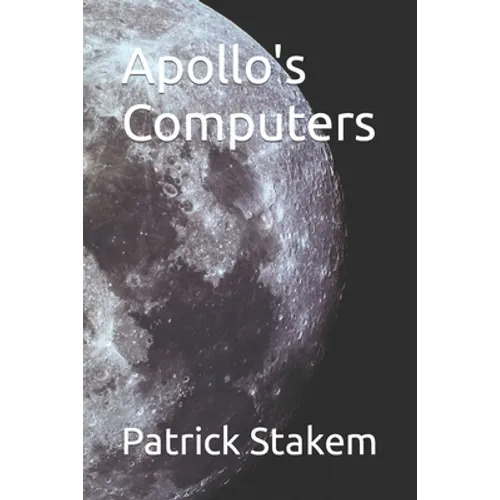
Apollo's Computers - Paperback
Available Offers
Fastest Delivery Tomorrow With Vip DealOrder within 1 hr 8 mins.
Instant 10% Discount On HDFC Banks Credit/Debit Cards EMI and CreditCard
Couldn't load pickup availability
Product Details
Flight Range: Up to 1,000 meters (3,280 feet)
Maximum Speed: 45 kilometers per hour (28 miles per hour)
Shipping And Return
For all orders exceeding a value of 100USD shipping is offered for free.
Returns will be accepted for up to 10 days of Customer’s receipt or tracking number on unworn items. You, as a Customer, are obliged to inform us via email before you return the item.
Otherwise, standard shipping charges apply. Check out our delivery Terms & Conditions for more details.
Product Description
by Patrick H. Stakem (Author)
Apollo was built in the era of "big iron" computer mainframes. The concept of an onboard computer for space missions was radically new. There was only one place in the world that could design the Apollo Guidance Computers, and that was MIT. It took most of the U.S.'s production of integrated circuits, another radical idea replacing individual vacuum tubes, to build the AGC's. It took 2,000 person-years of independent code review and validation to ensure that they would operate properly.Besides the technical challenges, the Apollo missions were a matter of National Prestige. In the Space Race between the United States and the Soviet Union, President Kennedy said we were going to the Moon and return safely before the end of the (1960's) decade, so we did. The flight computers for the Saturn launch vehicle were an evolution of earlier missile guidance efforts. The massive Saturn-V first stage was built from clustered Jupiter rockets. The earlier and smaller Saturn-I was built of clustered Redstone rockets, which were themselves a derivative of the early German V-2 rockets by the Von Braun Team. The Saturn's upper stages were all new technology, using liquid hydrogen and oxygen. The vehicle had to achieve and maintain a precise trajectory from its launch site in Florida, to lunar orbit, to the lunar surface and back, and then return to Earth. All this took unprecedented computing power. This book is a brief synopsis of the architecture and applications of the Apollo computers. There is a lot of archived material on the topic, and the list of references in this book is a good starting point. The amazing thing is, the first computer on another world was designed and built before computers were commodity items. It worked as planned. Although your phone has more computing power than the entire Saturn vehicle, you shouldn't trust it to get you to the moon and back.