An Old Hebrew Text of St. Matthew's Gospel: Translated and with an Introduction Notes and Appendices - Paperback
Available Offers
Fastest Delivery Tomorrow With Vip DealOrder within 1 hr 8 mins.
Instant 10% Discount On HDFC Banks Credit/Debit Cards EMI and CreditCard
Couldn't load pickup availability
Product Details
Flight Range: Up to 1,000 meters (3,280 feet)
Maximum Speed: 45 kilometers per hour (28 miles per hour)
Shipping And Return
For all orders exceeding a value of 100USD shipping is offered for free.
Returns will be accepted for up to 10 days of Customer’s receipt or tracking number on unworn items. You, as a Customer, are obliged to inform us via email before you return the item.
Otherwise, standard shipping charges apply. Check out our delivery Terms & Conditions for more details.
Product Description
by Hugh J. Schonfield (Author)
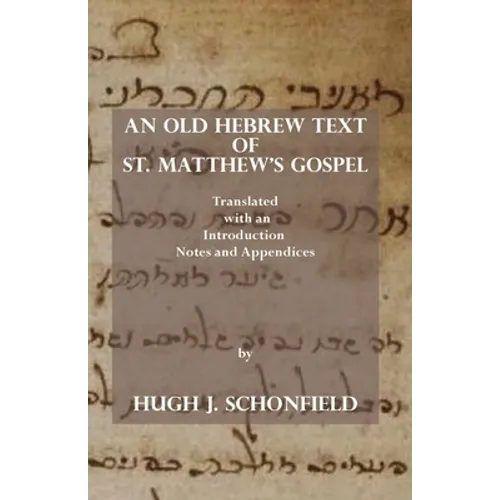
In the spring of 1925 the writer purchased from a London antiquarian bookseller a small volume, dated A.D. 1555, containing the Gospel of Matthew in Hebrew, followed by a series of Jewish objections to the Gospel to the number of twenty-three, also in Hebrew. The text of the Gospel was accompanied at the end of the volume by a Latin translation. A dedicatory epistle to Charles de Guise, Cardinal of Lorraine, relates how Jean du Tillet, Bishop of Brieu, while travelling in Italy in the year 1553, found the Hebrew manuscript among the Jews, and brought it back with him to Paris, where he commissioned a Hebrew scholar, Jean Mercier, to translate it into Latin. Mercier, however, has a slightly different tale to tell. In his own preface he states that the Bishop of Brieu had extorted the MS. from the Jews of Rome for the purpose of examination. Confirmatory evidence of this statement appears in the fact that, on 12th August 1553, Pope Julius III. signed a decree for the suppression of the Talmud on the representation of the anti-Semitic Pietro, Cardinal Caraffa, the Inquisitor-General, afterwards Pope Paul IV. This decree was carried into effect in Rome with great ruthlessness on Rosh Hashanna (Jewish New Year's Day), 9th September 1553, for not only were copies of the Talmud seized, on the plea that it was inimical to Christianity, but every Hebrew book on which the minions of the Inquisition could lay their hands. It is highly probable that the Bishop of Brieu found the Hebrew MS. of Matthew's Gospel among the confiscated books.