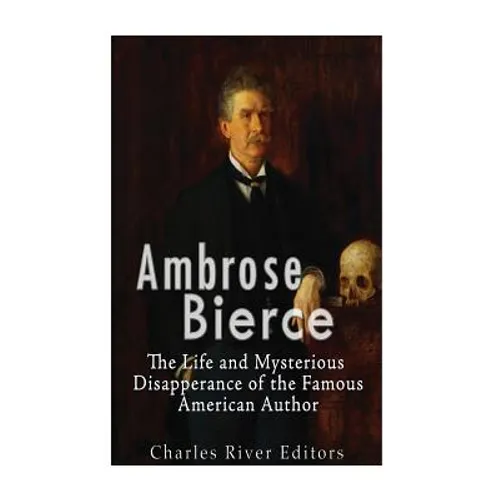
Ambrose Bierce: The Life and Mysterious Disappearance of the Famous American Author - Paperback
Available Offers
Fastest Delivery Tomorrow With Vip DealOrder within 1 hr 8 mins.
Instant 10% Discount On HDFC Banks Credit/Debit Cards EMI and CreditCard
Couldn't load pickup availability
Product Details
Flight Range: Up to 1,000 meters (3,280 feet)
Maximum Speed: 45 kilometers per hour (28 miles per hour)
Shipping And Return
For all orders exceeding a value of 100USD shipping is offered for free.
Returns will be accepted for up to 10 days of Customer’s receipt or tracking number on unworn items. You, as a Customer, are obliged to inform us via email before you return the item.
Otherwise, standard shipping charges apply. Check out our delivery Terms & Conditions for more details.
Product Description
by Charles River (Author)
*Includes pictures *Includes Bierce's quotes about his own life and career *Includes footnotes, online resources and a bibliography for further reading "History is an account, mostly false, of events, mostly unimportant, which are brought about by rulers, mostly knaves, and soldiers, mostly fools." - Ambrose Bierce Satirical commentary, memoirs from the agony of war, and horror stories of the supernatural have existed in literature since the beginning of the written word, and in virtually all global societies. The most lauded and familiar examples known to 21st century readers are emblematic of vast literary industries in comparison to previous eras. With an astonishing number of authors at liberty to self-publish and the rapid expansion of the relatively recent film industry, the world has never before seen such a vast expression of such genres. However, as epic film music can often trace its roots back to the Romantic movement of the 1800s, so can the written word. Mark Twain, a preeminent, globally-admired satirist, shared the stage with such wits as Britain's Oscar Wilde, delivering barb after barb laced with the two-edged charm of the old American South. Nearer the end of the 19th century, Stephen Crane penned Red Badge of Courage, considered the definitive novel on the American Civil War. These, and the ironically inventive horror stories penned by Edgar Allen Poe and the next century's H.P. Lovecraft, remain popular in the West's canon. Examples of these early authors are taught in the American school curriculum, having acquired distinction by the passing of time, often serving as plot and stylistic foundations for new works. One author who is less frequently mentioned among these iconic literary figures of war, horror, acidic poetry, and social satire, is Ambrose Gwinnet Bierce, a journalist, poet, short-story writer, novelist, fabulist, and writing master who embodied the literary affections of all three. As a satirist, Bierce was famously dubbed the "Mark Twain of the North." Inclusion of the "North," however, embodies several points of dissimilarity from the wit of Twain; sharp and lightning-clever like his counterpart from Missouri, Bierce the Ohioan made no pretense to Southern charm or allowed any room for a nuanced interpretation of his remarks. Once atop his profession, Bierce's venom was spewed at virtually everyone, in almost every walk of life. Any figure of public note in San Francisco came to know him as "Bitter Bierce," or by his initials, which in public life were often translated as "Almighty God Bierce." As a war author, Bierce is the only one of the great literary figures who actually served as a front-line soldier in the American Civil War. Walt Whitman and Twain were somewhat removed from the conflict by comparison. Twain, in fact, "dabbled" at being a soldier before deserting his Confederate unit. Bierce's often metaphysical and supernatural-tinged memoirs of his war service served as the ideal backdrop for the Poe-like "attraction to death in its most bizarre forms" and an affection for the ghost story as a "campfire tale." A master of the "ironic style of the grotesque," he outstripped even Poe in the minds of many readers as "the blackest of black humorists." H.P. Lovecraft, the most prominent author of the macabre in the early part of the following century, described Bierce's work as "grim and savage," but other critics disagree, citing the "detached, oddly companionable" personality of the storytelling that made the horror all the more penetrating. Indeed, many 20th and 21st century novels, short stories, films, and television serials have drawn their success, squarely from Bierce's models. In the end, Ambrose Bierce wrote the most interesting story of all by disappearing from the world in a final late-life Mexican adventure, amidst that country's revolution. A new theory of his demise emerges with each passing year.