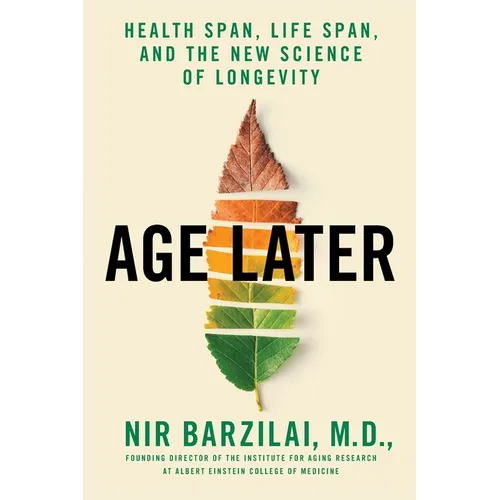
Age Later: Health Span, Life Span, and the New Science of Longevity - Paperback
Available Offers
Fastest Delivery Tomorrow With Vip DealOrder within 1 hr 8 mins.
Instant 10% Discount On HDFC Banks Credit/Debit Cards EMI and CreditCard
Couldn't load pickup availability
Product Details
Flight Range: Up to 1,000 meters (3,280 feet)
Maximum Speed: 45 kilometers per hour (28 miles per hour)
Shipping And Return
For all orders exceeding a value of 100USD shipping is offered for free.
Returns will be accepted for up to 10 days of Customer’s receipt or tracking number on unworn items. You, as a Customer, are obliged to inform us via email before you return the item.
Otherwise, standard shipping charges apply. Check out our delivery Terms & Conditions for more details.
Product Description
by Nir Barzilai (Author), Toni Robino (With)
How do some people avoid the slowing down, deteriorating, and weakening that plagues many of their peers decades earlier? Are they just lucky? Or do they know something the rest of us don't? Is it possible to grow older without getting sicker? What if you could look and feel fifty through your eighties and nineties?
Founder of the Institute for Aging Research at the Albert Einstein College of Medicine and one of the leading pioneers of longevity research, Dr. Nir Barzilai's life's work is tackling the challenges of aging to delay and prevent the onset of all age-related diseases including "the big four" diabetes, cancer, heart disease, and Alzheimer's. One of Dr. Barzilai's most fascinating studies features volunteers that include 750 SuperAgers--individuals who maintain active lives well into their nineties and even beyond--and, more importantly, who reached that ripe old age never having experienced cardiovascular disease, cancer, diabetes, or cognitive decline. In Age Later, Dr. Barzilai reveals the secrets his team has unlocked about SuperAgers and the scientific discoveries that show we can mimic some of their natural resistance to the aging process. This eye-opening and inspirational book will help you think of aging not as a certainty, but as a phenomenon--like many other diseases and misfortunes--that can be targeted, improved, and even cured.