Skip to content
Welcome To Our Store.
100,000+ Products for Home, Medical, Office & Classroom Needs
Search
Skip to product information
1 of 1

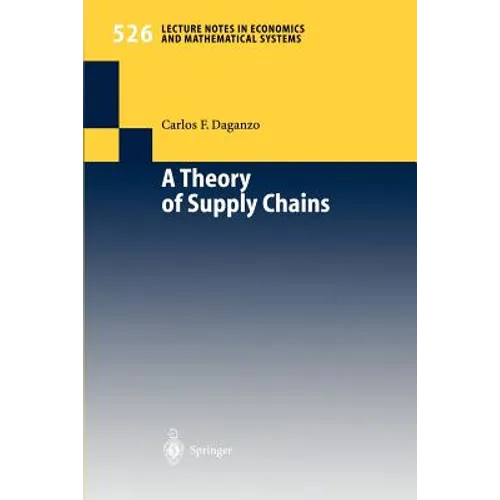
A Theory of Supply Chains - Paperback

$89.08
$89.08
Sale Sold out
Shipping calculated at checkout.
In stock (100 units), ready to be shipped

Available Offers

Fastest Delivery Tomorrow With Vip DealOrder within 1 hr 8 mins.

Instant 10% Discount On HDFC Banks Credit/Debit Cards EMI and CreditCard

Secure checkout with
  • American Express
  • Apple Pay
  • Diners Club
  • Discover
  • Google Pay
  • Mastercard
  • PayPal
  • Shop Pay
  • Visa

Flight Range: Up to 1,000 meters (3,280 feet)

Maximum Speed: 45 kilometers per hour (28 miles per hour)

For all orders exceeding a value of 100USD shipping is offered for free.

Returns will be accepted for up to 10 days of Customer’s receipt or tracking number on unworn items. You, as a Customer, are obliged to inform us via email before you return the item.

Otherwise, standard shipping charges apply. Check out our delivery Terms & Conditions for more details.

View Product Details
Shopping cart
Product Product subtotal Quantity Price Product subtotal
A Theory of Supply Chains - Paperback
$89.08/ea
$0.00
$89.08/ea $0.00

Product Description

by Carlos F. Daganzo (Author)

This work was stimulated by a comment made by a former student (Prof. Alan Erera of Georgia Tech) in connection with an inventory stabil- ity game he was going to play in one of his logistics classes. This was the well-known "beer-game" that is often played in business schools to illus- trate the "bullwhip" effect in supply chains. Al had said to me that he did not have to tell his students how to reorder replacement parts from the other members of the supply chain because he knew from experience that the order sizes the players would generate as the game progressed would become chaotic anyhow. Since I had not played the beer game, his asser- tion was intriguing to me. Why would such an unstructured game always lead to the same undesirable effect? Did it have something to do with psy- chology? What is it that players did to generate instabilities? I posed these to other people but could not get completely satisfactory an- questions swers. Thus, the bullwhip mystery remained, at least in my mind. Since inventory chains are "conservative" systems analogous to a traffic stream, and since traffic flow models exhibit similar effects (the instability of automobile platoons and of certain numerical methods being two nota- ble examples)' I suspected that traffic flow theory might shed some light on the puzzle.

Number of Pages: 125
Dimensions: 0.34 x 9.32 x 6.06 IN
Illustrated: Yes
Publication Date: February 13, 2003
you might like