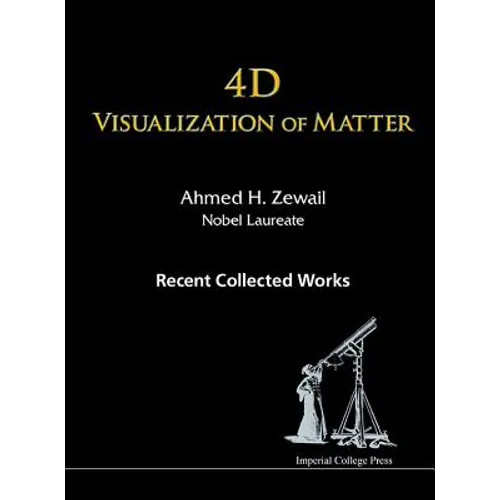
4D Visualization of Matter: Recent Collected Works of Ahmed H Zewail, Nobel Laureate - Paperback
Available Offers
Fastest Delivery Tomorrow With Vip DealOrder within 1 hr 8 mins.
Instant 10% Discount On HDFC Banks Credit/Debit Cards EMI and CreditCard
Couldn't load pickup availability
Product Details
Flight Range: Up to 1,000 meters (3,280 feet)
Maximum Speed: 45 kilometers per hour (28 miles per hour)
Shipping And Return
For all orders exceeding a value of 100USD shipping is offered for free.
Returns will be accepted for up to 10 days of Customer’s receipt or tracking number on unworn items. You, as a Customer, are obliged to inform us via email before you return the item.
Otherwise, standard shipping charges apply. Check out our delivery Terms & Conditions for more details.
Product Description
by Ahmed H. Zewail (Author)
Ever since the beginning of mankind's efforts to pursue scientific inquiry into the laws of nature, visualization of the very distant and the very small has been paramount. The examples are numerous. A century ago, the atom appeared mysterious, a "raisin or plum pie of no structure," until it was visualized on the appropriate length and time scales. Similarly, with telescopic observations, a central dogma of the cosmos was changed and complexity yielded to simplicity of the heliocentric structure and motion in our solar system.
For matter, in over a century of developments, major advances have been made to explore the inner microscopic structures and dynamics. These advances have benefited many fields of endeavor, but visualization was incomplete; it was limited either to the 3D spatial structure or to the 1D temporal evolution. However, in systems with myriads of atoms, 4D spatiotemporal visualization is essential for dissecting their complexity. The biological world is rich with examples, and many molecular diseases cannot be fully understood without such direct visualization, as, for example, in the case of Alzheimer's and Parkinson's. The same is true for phenomena in materials science, chemistry, and nanoscience.
This anthology is an account of the collected works that have emerged over the past decade from Caltech. Through recent publications, the volume provides overviews of the principles, the electron-based techniques, and the applications made. Thanks to advances in imaging principles and technology, it is now possible with 4D electron microscopy to reach ten orders of magnitude improvement in time resolution while simultaneously conserving the atomic spatial resolution in visualization. This is certainly a long way from Robert Hooke's microscopy, which was recorded in his 1665 masterpiece Micrographia.
Front Jacket
Ever since the beginning of mankind's efforts to pursue scientific inquiry into the laws of nature, visualization of the very distant and the very small has been paramount. The examples are numerous. A century ago, the atom appeared mysterious, a "raisin or plum pie of no structure," until it was visualized on the appropriate length and time scales. Similarly, with telescopic observations, a central dogma of the cosmos was changed and complexity yielded to simplicity of the heliocentric structure and motion in our solar system.
For matter, in over a century of developments, major advances have been made to explore the inner microscopic structures and dynamics. These advances have benefited many fields of endeavor, but visualization was incomplete; it was limited either to the 3D spatial structure or to the 1D temporal evolution. However, in systems with myriads of atoms, 4D spatiotemporal visualization is essential for dissecting their complexity. The biological world is rich with examples, and many molecular diseases cannot be fully understood without such direct visualization, as, for example, in the case of Alzheimer's and Parkinson's. The same is true for phenomena in materials science, chemistry, and nanoscience.
This anthology is an account of the collected works that have emerged over the past decade from Caltech. Through recent publications, the volume provides overviews of the principles, the electron-based techniques, and the applications made. Thanks to advances in imaging principles and technology, it is now possible with 4D electron microscopy to reach ten orders of magnitude improvement in time resolution while simultaneously conserving the atomic spatial resolution in visualization. This is certainly a long way from Robert Hooke's microscopy, which was recorded in his 1665 masterpiece Micrographia.