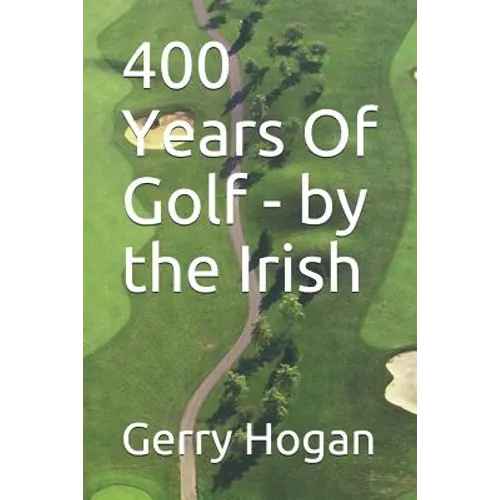
400 Years Of Golf - by the Irish - Paperback
Available Offers
Fastest Delivery Tomorrow With Vip DealOrder within 1 hr 8 mins.
Instant 10% Discount On HDFC Banks Credit/Debit Cards EMI and CreditCard
Couldn't load pickup availability
Product Details
Flight Range: Up to 1,000 meters (3,280 feet)
Maximum Speed: 45 kilometers per hour (28 miles per hour)
Shipping And Return
For all orders exceeding a value of 100USD shipping is offered for free.
Returns will be accepted for up to 10 days of Customer’s receipt or tracking number on unworn items. You, as a Customer, are obliged to inform us via email before you return the item.
Otherwise, standard shipping charges apply. Check out our delivery Terms & Conditions for more details.
Product Description
by Gerry Hogan (Author)
West Scotland is so close to the north east of Ireland that each country can be seen from high ground in the other. A mere 24 kilometers or 15 miles separates the two coasts at their closest. It is not surprising therefore, that similarities in sport, language and culture are to be found in both countries. Scotland received the Irish game of hurling and renamed it shinty; they received the gaelic language and called it gallic, and accepted christianity from the Irish monks. After the Ulster Plantation of 1608, the large flow of Scots into Ulster brought presbyterianism and golf to Ireland.400 years is a long time and that's how long golf has been played in Ireland (and in England). That more ancient stick and ball game played in Ireland called hurling helped the Irish to readily accept golf. It took another two and a half centuries before the first golf clubs as we know them emerged in Ireland. The Irish clubs then established the Golfing Union of Ireland to administer their game. This was the first such national organisation (the R&A is not a national body) in the world and was the model followed by other countries. Ireland was also the first to introduce a coherent, logical, nationwide handicap system.Any activity undertaken by humankind never takes place in a vacuum; the historical context has a substantial say in it. So it was that one of the greatest catastrophes in the then known world- the Great Irish Famine (1845-1847), was the principal reason why today a large Irish diaspora is scattered around the globe, in England, Australia and especially America. For various reasons, the Irish and their descendants who ended up in the U.S.A. found sport to be one social and professional activity for which they had a particular talent, and which was a sure way to climb the social ladder. Irish names are to be found among the star performers in early professional boxing, in baseball, in athletics (including the Olympics) and of relevance here, in golf. Until the last twenty years, more Irish names appeared on the U.S. Open Golf Trophy than on the British one The following pages explore what the Irish brought to golf at home and abroad.