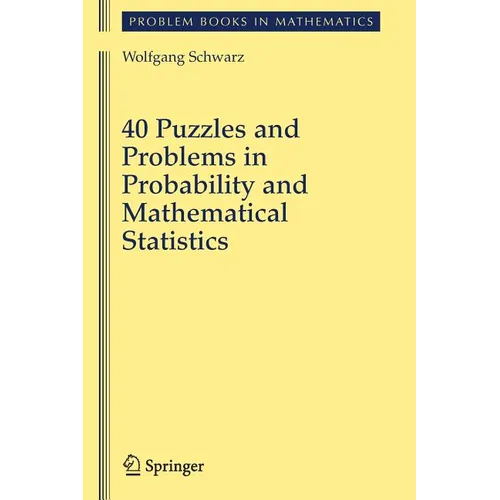
40 Puzzles and Problems in Probability and Mathematical Statistics - Paperback
Available Offers
Fastest Delivery Tomorrow With Vip DealOrder within 1 hr 8 mins.
Instant 10% Discount On HDFC Banks Credit/Debit Cards EMI and CreditCard
Couldn't load pickup availability
Product Details
Flight Range: Up to 1,000 meters (3,280 feet)
Maximum Speed: 45 kilometers per hour (28 miles per hour)
Shipping And Return
For all orders exceeding a value of 100USD shipping is offered for free.
Returns will be accepted for up to 10 days of Customer’s receipt or tracking number on unworn items. You, as a Customer, are obliged to inform us via email before you return the item.
Otherwise, standard shipping charges apply. Check out our delivery Terms & Conditions for more details.
Product Description
by Wolf Schwarz (Author)
The present book is based on the view that cognitive skills are best acquired by solving challenging, non-standard probability problems. Many puzzles and problems presented here are either new within a problem solving context (although as topics in fundamental research they are of course long known) or are variations of classical problems which follow directly from elementary concepts. A small number of particularly instructive problems is taken from previous sources which in this case are generally given. This book contains far more problems of a statistical nature than the competition. It will become a handy resource for professors looking for problems to assign for a course, and will be of interest to undergraduate math students, as well as a more general audience of amateur scientists.
Back Jacket
"40 Puzzles and Problems in Probability and Mathematical Statistics" is intended to teach the reader to think probabilistically by solving challenging, non-standard probability problems. The motivation for this clearly written collection lies in the belief that challenging problems help to develop, and to sharpen, our probabilistic intuition much better than plain-style deductions from abstract concepts. The selected problems fall into two broad categories. Problems related to probability theory come first, followed by problems related to the application of probability to the field of mathematical statistics. All problems seek to convey a non-standard aspect or an approach which is not immediately obvious.
The word puzzles in the title refers to questions in which some qualitative, non-technical insight is most important. Ideally, puzzles can teach a productive new way of framing or representing a given situation. Although the border between the two is not always clearly defined, problems tend to require a more systematic application of formal tools, and to stress more technical aspects. Thus, a major aim of the present collection is to bridge the gap between introductory texts and rigorous state-of-the-art books.
Anyone with a basic knowledge of probability, calculus and statistics will benefit from this book; however, many of the problems collected require little more than elementary probability and straight logical reasoning. To assist anyone using this book for self-study, the author has included very detailed step-for-step solutions of all problems and also short hints which point the reader in the appropriate direction.