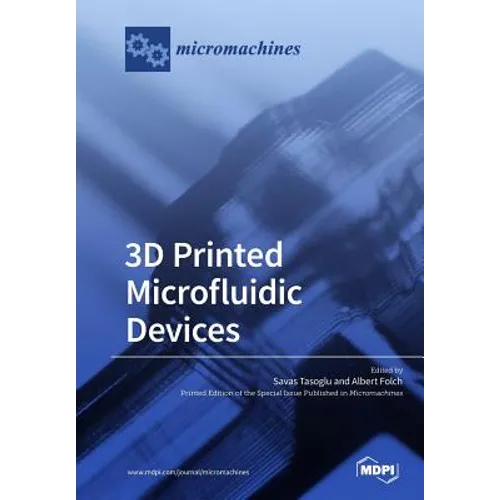
3D Printed Microfluidic Devices - Paperback
Available Offers
Fastest Delivery Tomorrow With Vip DealOrder within 1 hr 8 mins.
Instant 10% Discount On HDFC Banks Credit/Debit Cards EMI and CreditCard
Couldn't load pickup availability
Product Details
Flight Range: Up to 1,000 meters (3,280 feet)
Maximum Speed: 45 kilometers per hour (28 miles per hour)
Shipping And Return
For all orders exceeding a value of 100USD shipping is offered for free.
Returns will be accepted for up to 10 days of Customer’s receipt or tracking number on unworn items. You, as a Customer, are obliged to inform us via email before you return the item.
Otherwise, standard shipping charges apply. Check out our delivery Terms & Conditions for more details.
Product Description
by Savas Tasoglu (Guest Editor), Albert Folch (Guest Editor)
3D printing has revolutionized the microfabrication prototyping workflow over the past few years. With the recent improvements in 3D printing technologies, highly complex microfluidic devices can be fabricated via single-step, rapid, and cost-effective protocols as a promising alternative to the time consuming, costly and sophisticated traditional cleanroom fabrication. Microfluidic devices have enabled a wide range of biochemical and clinical applications, such as cancer screening, micro-physiological system engineering, high-throughput drug testing, and point-of-care diagnostics. Using 3D printing fabrication technologies, alteration of the design features is significantly easier than traditional fabrication, enabling agile iterative design and facilitating rapid prototyping. This can make microfluidic technology more accessible to researchers in various fields and accelerates innovation in the field of microfluidics. Accordingly, this Special Issue seeks to showcase research papers, short communications, and review articles that focus on novel methodological developments in 3D printing and its use for various biochemical and biomedical applications.