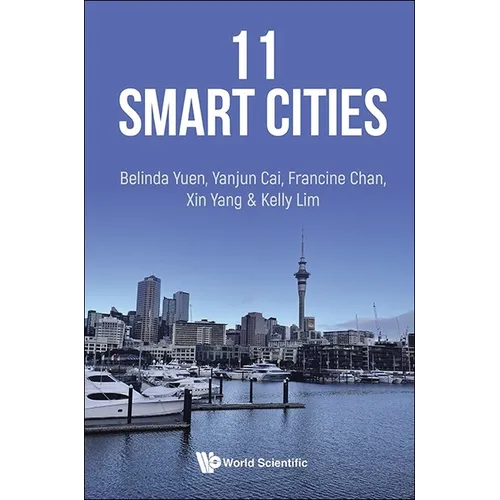
11 Smart Cities - Hardcover
Available Offers
Fastest Delivery Tomorrow With Vip DealOrder within 1 hr 8 mins.
Instant 10% Discount On HDFC Banks Credit/Debit Cards EMI and CreditCard
Couldn't load pickup availability
Product Details
Flight Range: Up to 1,000 meters (3,280 feet)
Maximum Speed: 45 kilometers per hour (28 miles per hour)
Shipping And Return
For all orders exceeding a value of 100USD shipping is offered for free.
Returns will be accepted for up to 10 days of Customer’s receipt or tracking number on unworn items. You, as a Customer, are obliged to inform us via email before you return the item.
Otherwise, standard shipping charges apply. Check out our delivery Terms & Conditions for more details.
Product Description
by Yanjun Cai Francine Chan Belinda Yuen (Author)
This book discusses smart city implementation in 11 smart cities -- Auckland, Boston, Copenhagen, Gothenburg, Guangzhou, Hangzhou, Melbourne, Milan, Seoul, Tokyo, and Vancouver. The cities encompass a range of smart city development on selected critical issues in economic prosperity (future digital economy, smart retail, smart tourism), social inclusion (digital inclusion, digital placemaking, smart health service, smart youth empowerment), and environmental sustainability (climate resilience action, circular economy, smart climate action). The focus is on their challenges and course of action in and around the socio-technical systems and processes of sustainability transition. The chapters focus on emerging issues, enabling technologies, practical approaches, policies and case studies. The analysis recognises that smart city development takes place in a social context that, to some degree, will influence the adoption and effectiveness of technologies and ultimately, determine whether they meet end-user satisfaction. Smart city development is pivoted on technological changes, connectivity, and data, but also on people and government involvement and the transformation of urban living practices and conditions. This book aims to deepen dialogues on possible smart city strategies from the perspective of how people, organisations (e.g., processes, communication networks), and technologies interact to achieve individual, organisational, or societal goals.