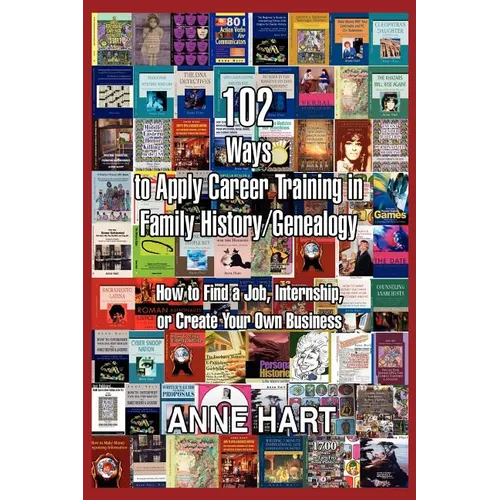
102 Ways to Apply Career Training in Family History/Genealogy: How to Find a Job, Internship, or Create Your Own Business - Paperback
Available Offers
Fastest Delivery Tomorrow With Vip DealOrder within 1 hr 8 mins.
Instant 10% Discount On HDFC Banks Credit/Debit Cards EMI and CreditCard
Couldn't load pickup availability
Product Details
Flight Range: Up to 1,000 meters (3,280 feet)
Maximum Speed: 45 kilometers per hour (28 miles per hour)
Shipping And Return
For all orders exceeding a value of 100USD shipping is offered for free.
Returns will be accepted for up to 10 days of Customer’s receipt or tracking number on unworn items. You, as a Customer, are obliged to inform us via email before you return the item.
Otherwise, standard shipping charges apply. Check out our delivery Terms & Conditions for more details.

Product Description
by Anne Hart (Author)
Here are 102+ ways to use training in family history and genealogy when applied to real-world careers in education, business, or government, including creative entrepreneurial start-ups.
With the future marriage of genealogy to smart cards, online databases, or similar authentication technology for family history, population registration (census), and library research, it may be easier to research family lines, not only by DNA matches through DNA testing for deep ancestry, but also with smart, electronic cards designed for electronic identity. It's also a way to track military records as another way to trace family history.
Careers and research may focus on various state libraries or historical associations. History and family studies are part of an interdisciplinary liberal arts program that emphasizes research and writing. Journalism courses help round out your ability to express in plain language the results of your reading, explorations, and interpretations.
Obtaining a degree or even taking one course or self-study in Family History can lead to broad, interdisciplinary careers. Graduate work in library science, law, journalism, public history, or genetics counseling (with a double major in the life sciences and social work) also lead to careers in which an historical education may be used. Public history is a field where you can pursue graduate degrees, including a doctorate. A degree in family history and/or public history can lead to entrepreneurship or becoming a corporate executive.
Most jobs don't require a specific major, but rather analytical training and training in writing. If you're interested in taking courses or obtaining a degree or doing graduate work in history, family, home, social science, or area studies, focus on obtaining those analytical skills and good journalism skills for expressing in plain language for the public what you learned in your history and genealogy courses. See the personal history course link at http: //www.newswriting.net.