102 (Ceylon) Squadron: RAF Bomber Command Squadron Profiles - Paperback
Available Offers
Fastest Delivery Tomorrow With Vip DealOrder within 1 hr 8 mins.
Instant 10% Discount On HDFC Banks Credit/Debit Cards EMI and CreditCard
Couldn't load pickup availability
Product Details
Flight Range: Up to 1,000 meters (3,280 feet)
Maximum Speed: 45 kilometers per hour (28 miles per hour)
Shipping And Return
For all orders exceeding a value of 100USD shipping is offered for free.
Returns will be accepted for up to 10 days of Customer’s receipt or tracking number on unworn items. You, as a Customer, are obliged to inform us via email before you return the item.
Otherwise, standard shipping charges apply. Check out our delivery Terms & Conditions for more details.
Product Description
by Chris Ward (Author)
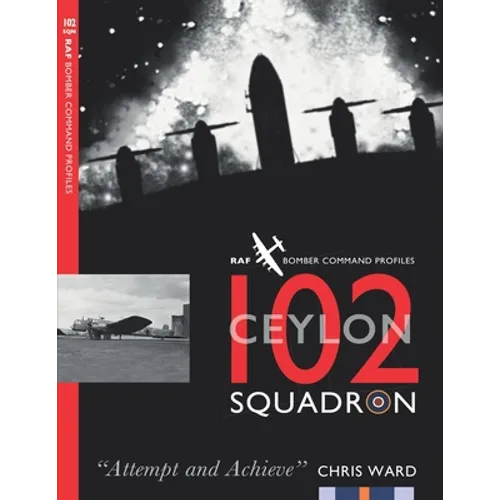
102 (Ceylon) Squadron was a mainstay of 4 Group from the outbreak of war to the end of hostilities, operating for the first time on the day after war was declared. 4 Group was equipped with the twin-engine Armstrong Whitworth Whitley, a slow but immensely reliable aircraft capable of remaining aloft for more than twelve hours. The Whitley was employed initially in a pioneering role to deliver propaganda leaflets to populations as far away as Poland, Czechoslovakia, and Austria. Such sorties exposed the crews to extremes of cold in unheated aircraft but taught them also how to navigate over a blacked-out Europe at night at a time when the rest of Bomber Command was trained only for daylight operations.
The squadron was attached to 18 Group of Coastal Command for a short period during the autumn of 1940 and undertook convoy protection duties. It was during this period that P/O Leonard Cheshire joined the squadron to begin an illustrious operational career that would see him progress through the ranks to command 76 Squadron and, later, the famous 617 Squadron (Dambusters), and to earn the award of a Victoria Cross. A contemporary of Cheshire was P/O Henry "Dinghy" Young, who would be selected as a flight commander under W/C Guy Gibson for Operation Chastise, the epic attack on the Ruhr Dams, from which he would fail to return. At the end of 1941 the squadron converted to the four-engine Handley Page Halifax, an aircraft with a troubled gestation period, which saw it withdrawn from operations for modifications on a number of occasions. The type was not suited to retrospective modifications, and this meant that 4 Group squadrons were constantly exchanging one variant for another. The Mk II/V Halifax underwent many design changes in an attempt to improve its performance and shed its questionable reputation. However it saw 102 Squadron through the campaigns of 1943 against the Ruhr, Hamburg and Berlin, the last-mentioned extending through the winter of 1943/44. Late in 1943, 4 Group began to re-equip with the much-improved Hercules-powered Mk III Halifax. It would be some time before the type reached 102 (Ceylon) Squadron. At the time, the squadron was among those operating the Merlin-powered variants which, following the disaster of Leipzig in February 1944, was withdrawn from operations over Germany. Finally, in May 1944, the squadron returned to the forefront of operations with Mk IIIs and later Mk IVs. In the autumn of 1944, the squadron was among a number from 42 Base employed to ferry petrol to Europe to fuel the advance into Germany. During the course of its wartime career, the squadron suffered the third highest operational losses in Bomber Command, the highest losses in 4 Group and the highest Whitley losses. At the war's end 102 (Ceylon) Squadron was transferred to the newly formed Transport Command.