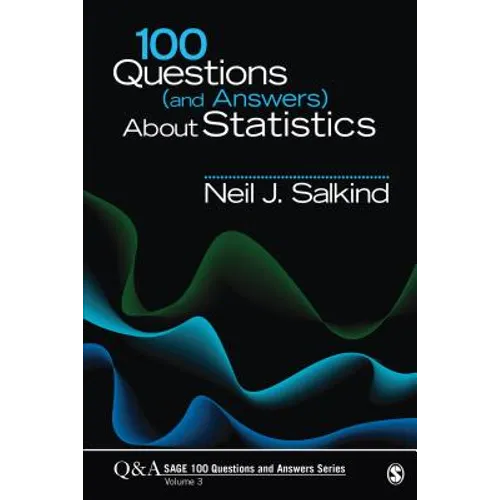
100 Questions (and Answers) About Statistics - Paperback
Available Offers
Fastest Delivery Tomorrow With Vip DealOrder within 1 hr 8 mins.
Instant 10% Discount On HDFC Banks Credit/Debit Cards EMI and CreditCard
Couldn't load pickup availability
Product Details
Flight Range: Up to 1,000 meters (3,280 feet)
Maximum Speed: 45 kilometers per hour (28 miles per hour)
Shipping And Return
For all orders exceeding a value of 100USD shipping is offered for free.
Returns will be accepted for up to 10 days of Customer’s receipt or tracking number on unworn items. You, as a Customer, are obliged to inform us via email before you return the item.
Otherwise, standard shipping charges apply. Check out our delivery Terms & Conditions for more details.
Product Description
by Neil J. Salkind (Author)
In an increasingly data-driven world, it is more important than ever for students as well as professionals to better understand basic statistical concepts. 100 Questions (and Answers) About Statistics addresses the essential questions that students ask about statistics in a concise and accessible way. It is perfect for instructors, students, and practitioners as a supplement to more comprehensive materials, or as a desk reference with quick answers to the most frequently asked questions.
"The key strength of this book is the straightforward approach. I love the to-the-point question-and-answer format. . . . This book would be useful in both statistics and research methods courses . . . [and] in math tutoring labs. I love the tone the author uses, as it is not condescending. Students will be encouraged." --Jamie Brown, Mercer University "The sequencing of the questions works very well--from the most basic to the more intimidating questions often asked by students in an intro class. . . . If Dr. Salkind is the author, I know it will be well-written, and both entertaining and easy to understand." --Linda Martinez, California State University, Long Beach "Practical examples from all types of work: showing the steps to do each analysis and then the ways to use the results responsibly." --Jennifer R. Salmon, Eckerd College